Commercial
Restoration Services
When disaster affects a commercial property, every hour can matter. Reliant coordinates scalable restoration services for property managers, facility operators, and commercial organizations across Dallas–Fort Worth.
Facilities We Service
Reliant has the capabilities and equipment to manage mitigation and reconstruction for diverse commercial property types.
Property Management
A defined property contact can coordinate site access, affected areas, occupants, approvals, and available project records.
Multifamily & Apartments
Multi-unit planning can address containment, extraction, drying, access, documentation, and phased work based on actual conditions.
Offices & Retail
Water, fire, smoke, and storm scopes are assessed with operating hours, access restrictions, and critical areas in mind.
Hospitality & Hotels
Mitigation planning can account for occupied and restricted areas while property management directs guest and staff communications.
Education & Institutions
Restoration planning for schools, religious organizations, and institutions considers site safety, access, and scheduled use.
Healthcare & Medical
Coordinated mitigation for clinics and medical offices, adapting containment strategies case-by-case to support your facility requirements.
Industrial & Warehouses
Extraction, drying, cleaning, temporary protection, and reconstruction needs are scoped for the affected footprint and materials.
Emergency Preparedness Guidance
Planning before a loss helps property teams know who can authorize work, where critical utilities are located, and how responders will access affected areas. Restoration planning should support—not replace—the property’s life-safety and emergency-action plans.
- Identify and document all critical utility shut-offs (water, gas, electric).
- Establish clear communication chains for property management and tenants.
- Define pre-authorized restoration response limits to prevent approval delays.
- Maintain current property, vendor, and emergency-contact records.
Keep this information with the property team: a current contact and authorization list, safe access instructions, utility information, building or unit plans, priority areas, and any known hazardous-material records. For a fuller checklist, see the commercial property emergency-response planning guide.

Mitigation to Reconstruction
Reliant can coordinate mitigation and related reconstruction as one project when the agreed scope, authorization, permits, materials, and site conditions allow.
Emergency Mitigation
After safety and access are confirmed, the team assesses extraction, containment, temporary protection, and drying needs.
Documentation & Communication
Available condition photos, moisture readings, work notes, estimates, and progress records are organized for the customer’s files.
Commercial Reconstruction
When mitigation is complete, needed repairs can be scoped with project-specific approvals, permits, materials, trades, and scheduling.
Phases of Commercial Recovery
Understanding the distinct stages of property recovery helps facility teams set expectations for business continuity and occupied-facility constraints.
Priorities and phases are set from life-safety restrictions, active damage, affected materials and systems, access, occupant needs, operational priorities, and required approvals—not a fixed sequence for every property.
Stabilization
Initial steps to secure the property, such as emergency board-up, temporary fencing, and addressing immediate structural hazards to allow safe assessment.
Mitigation
Actions taken to limit further damage, including water extraction, structural drying, and smoke residue containment.
Remediation
Targeted processes to address specific contaminants, such as mold remediation or biohazard cleanup, following specialized protocols.
Restoration
The broader process of returning affected contents and property materials to a pre-loss condition through specialized cleaning and repair.
Reconstruction
The rebuilding phase where heavily damaged materials are replaced. This phase requires coordinated project approvals, permits, and trade sequencing.
Authority & Responsibilities
Commercial restoration involves multiple stakeholders. Clear lines of responsibility protect business continuity and site safety. Property, fire, code, and public-health authorities—along with the authorized facility team—control occupancy and re-entry decisions.
Authorities & Facility Management
Determine when a building is safe to enter, authorize restoration work, communicate with tenants about occupied-facility constraints, and control project records sharing with insurers or TPAs (Third-Party Administrators).
Reliant Disaster Group
Executes the agreed restoration scope, sequences mitigation and reconstruction, and provides organized project documentation. Reliant coordinates services based on current availability but does not guarantee safety, coverage, approval, response time, or outcomes.
Commercial Intake & Continuity Checklist
- Confirm life-safety and emergency-action plans are executed.
- Wait for official clearance from fire/code authorities before site entry.
- Identify critical business-continuity priorities and restricted areas.
- Review insurance requirements and TPA coordination preferences.
- Gather property documentation, including utility maps and asbestos reports.
- Define decision-makers for work authorization and expense approval.
- Retain safe condition photos, authority instructions, authorizations, estimates, work notes, progress records, and invoices in the property file.
Commercial Work in the Field
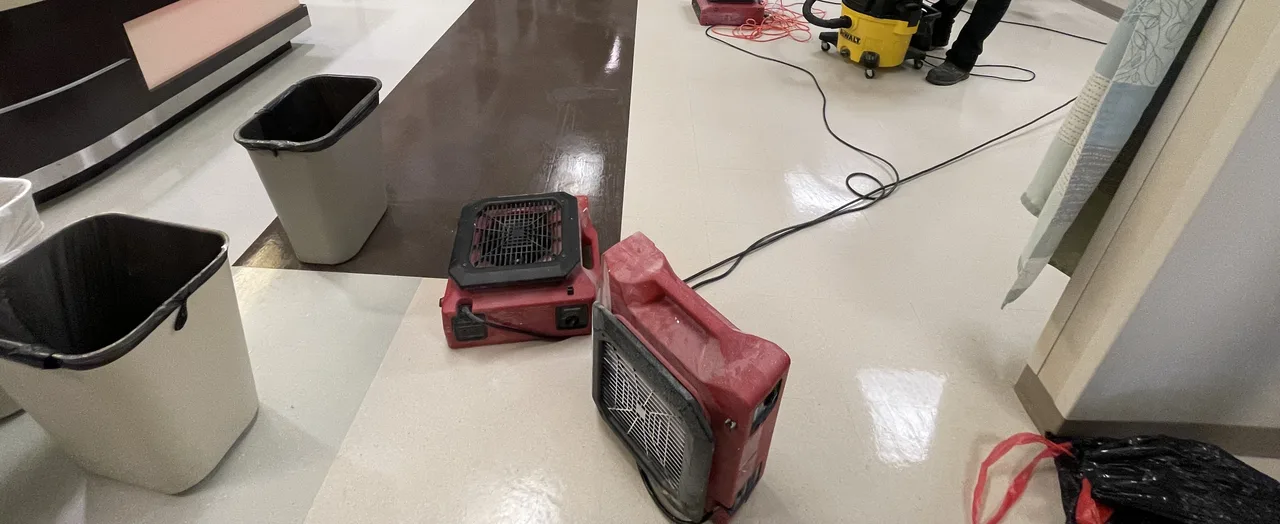
Review an anonymous, privacy-checked North Texas healthcare water-loss cleanup documented with owner-approved RDG photography.
Safe first steps
Protect people first: isolate affected areas where appropriate, notify your facility contacts, preserve photos and incident notes, and identify any critical operations that need a phased plan.
Keep useful records
Keep date-stamped photos, notes about the cause, receipts, and communications. Available project photos, readings, and work records can be organized for your files; policy and coverage decisions remain with your insurer.
Project documentation supportCommercial Restoration Questions
Practical answers for owners and property managers planning a response.
What commercial properties does Reliant serve?
Reliant serves Dallas–Fort Worth property managers and owners of multifamily, office, retail, hospitality, industrial, educational, and medical-office properties. Service depends on site conditions, scope, safety access, and current availability.
What should a property manager do first after commercial water damage?
Address life safety first, follow emergency-official and utility guidance, and stop the water source only when it is safe to do so. Then document visible conditions and call to discuss extraction, drying, and access needs.
Can mitigation and reconstruction be planned together?
Yes. Reliant can assess mitigation needs and plan related reconstruction work. Scope, approvals, permits, materials, and schedules are determined for each property.
Does Reliant help with commercial emergency planning?
Reliant can help property teams identify restoration contacts, utility shut-offs, access requirements, priority areas, and documentation needs. This supports—but does not replace—the property’s life-safety and emergency-action plans.
Professional Referrals & Partnerships
Reliant works alongside property managers and other authorized project participants. Responsibilities, access, scope, records, and communication contacts are defined for each restoration project.
Commercial Restoration Capabilities
Contact Reliant Disaster Group for rapid response and full-service commercial restoration support.