Water Damage Restoration
Arlington, TX
From slab leaks under East Arlington ranch homes to burst supply lines in UTA apartment stacks, call to coordinate water extraction and structural drying.
DFW
Service Area
24/7
Emergency Dispatch
Records
Documentation Support
Homes + Business
Property Types
24/7 Emergency Dispatch
Call any time for DFW service availability
Residential & Commercial
Restoration support for homes and businesses
Claim Documentation Support
Photos, records, and project details on request
Damage Assessments
Discuss your property and next steps with our team
Water Damage Restoration in Arlington
Arlington's postwar building stock makes water losses varied. The 1960s and '70s boom left slab-on-grade and pier-and-beam ranch homes in East and North Arlington, while Southwest Arlington near I-20 has newer slab subdivisions. A hidden under-slab leak in a Woodland West ranch differs from a failed washer line in a College Park duplex, so the drying approach should follow on-site conditions.
Arlington's expansive North Texas clay drives a large share of these losses. As the soil swells with spring rain and shrinks through summer drought, aging slabs flex and the copper supply and drain lines running beneath them crack — often leaking quietly for weeks until a warm spot appears on the floor or the water bill jumps. By the time it's noticed, moisture has usually wicked up into sill plates, baseboards, and drywall, which is why we moisture-map the full affected footprint instead of drying only the visibly wet area.
The multifamily side of Arlington has added planning needs because one unit's supply-line failure may affect shared walls, floors, and neighboring spaces. The appropriate plan depends on safety access, the source, affected units and materials, moisture conditions, authorization, project scope, and current service availability.
Common Causes in Arlington
- Under-slab supply and drain line cracks from clay-soil movement in Arlington's 1960s–70s slab-on-grade ranch homes across East and Central Arlington
- Burst pipes during hard freezes in mid-century homes with un-insulated supply lines in garages, attics, and exterior walls
- Multifamily unit-to-unit leaks around UTA, College Park, and the Cooper Street and Collins corridors migrating between floors
- Water heater and washing machine supply-line failures — the most frequent everyday claim we see across Arlington
- Flash flooding along Village Creek, Johnson Creek, and Rush Creek pushing water into low-lying homes near Lake Arlington
- HVAC condensate drain clogs and overflows through the long North Texas cooling season
Our Arlington Water Damage Restoration Process
Dispatch & Assessment
Call to coordinate an assessment. If safe, stop the water source and document conditions; moisture mapping can help define the affected area.
Water Extraction
Truck-mounted extractors pull standing water from floors, carpet, and pad. In Arlington's pier-and-beam ranch homes we also pump out and address water trapped in the crawl space beneath the structure.
Structural Drying
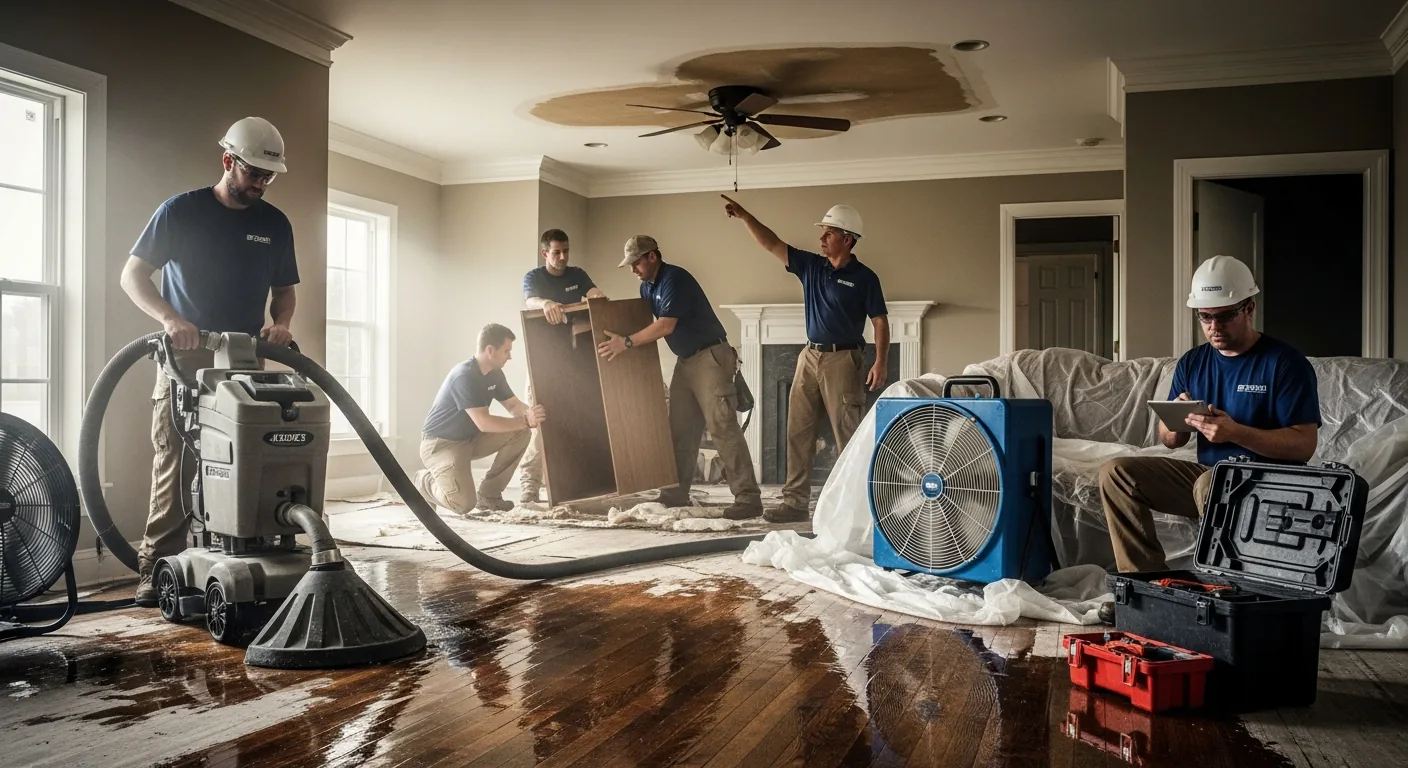
Air movers and LGR dehumidifiers are placed by psychrometric calculation, not guesswork. Saturated drywall, baseboards, and flooring that can't be saved are removed under containment to speed the dry-out.
Daily Monitoring & Verification
We take daily moisture readings and adjust equipment until every material hits its dry standard, then document verification for your insurance file.
Repairs & Reconstruction
The repair scope can include affected drywall, paint, flooring, and trim after moisture conditions and removed materials are documented.
Project Documentation in Arlington
Water-loss coverage depends on the policy and source of water. Keep photos, moisture records, and repair documentation for your insurer.
An itemized estimate can separate plumbing access, mitigation, and repairs for the property owner's records.
Arlington Water Damage Restoration FAQs
What should I do after water enters my Arlington home?
If it is safe, stop the water source and move items away from the affected area. Call to coordinate an assessment and drying plan.
My East Arlington slab home has a warm spot on the floor and a high water bill — is it a slab leak?
Those are the two classic signs of an under-slab leak, and they're common in Arlington's 1960s–70s slab homes because shifting clay soil cracks the plumbing beneath the foundation. We confirm with thermal imaging and moisture mapping, coordinate leak detection, and handle both the drying and the rebuild after plumbing access.
Does homeowners insurance cover water damage in Arlington?
Coverage depends on the policy and source of water. Contact the insurer and retain photos, moisture records, and repair documentation.
Can you handle a water leak between units in an Arlington apartment near UTA?
Yes. The multifamily stock around UTA and the stadium district is prone to leaks that migrate between units. We contain at unit boundaries, moisture-map into adjacent units only where readings justify it, and coordinate with property management and multiple carriers.
How long does structural drying take in Arlington's humidity?
Most residential dry-outs run 3–5 days with daily monitoring. Summer humidity and dense materials like hardwood can extend that, so we verify with moisture meters rather than guessing by the calendar.
Do you dry crawl-space flooding under older Arlington ranch homes?
Yes — the pier-and-beam ranch homes in North and East Arlington trap water in the crawl space after a leak or heavy rain. We pump it out, dry the subfloor and framing, and treat the enclosed space to head off mold.
More Services in Arlington
Water Damage Restoration Nearby
Request Emergency Service
24/7 dispatch availability, documentation assistance, and restoration support from mitigation through reconstruction.